Why Does Mine Sediment Pond Outlet TSS Rise After Rain?
Use rainfall, flow, and test results to trace sediment sources and assess pond capacity. Includes a diagnostic matrix, a worked TSS load example, and checks to run after corrective work.
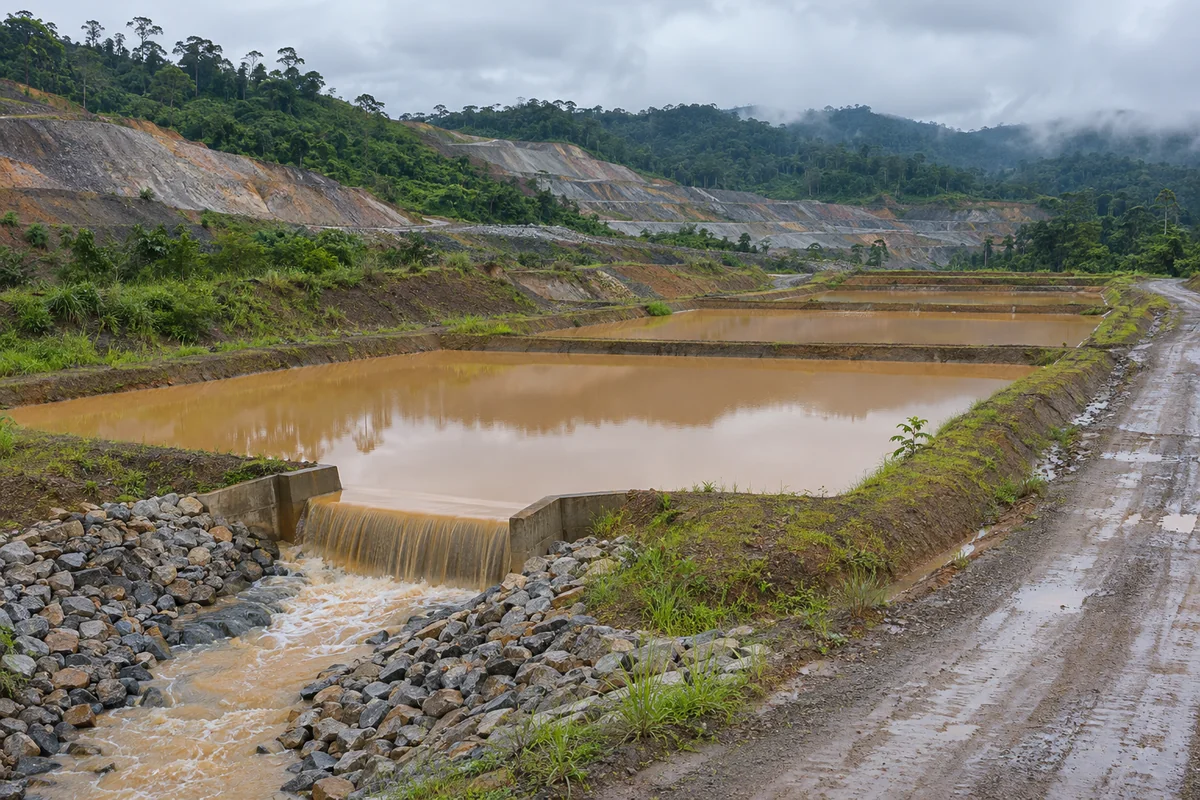
Start with the sequence of the storm
After rain, water at the sediment pond outlet looks more turbid. Laboratory results then show a rise in total suspended solids (TSS). Before choosing a response, establish when the increase began. Did incoming runoff carry more sediment, did some water travel too quickly through the pond, or did settled material get stirred up again?
Build one timeline from rainfall, flow or water level, turbidity, laboratory TSS, and the pumping and treatment logs. Align their timestamps. Record any changes in runoff routing, equipment interruptions, or dredging. One outlet sample describes conditions at the time of sampling. Its timing relative to rainfall and inflow helps narrow the possible causes.
- Build the timelineAlign rainfall, water levels, flow, test results, and operating changes.
- Compare monitoring pointsTrace runoff sources, the inlet, individual cells, and the outlet.
- Test the likely causesChoose checks that distinguish source, capacity, and treatment issues.
Where practicable, collect data before rain, during the rise in flow, near the peak, and during recession. Allow for travel time from the inlet to the outlet when interpreting the records. Use accessible monitoring points or remote observations when field access is unsafe.
Distinguish four patterns behind rising outlet TSS
Use this table to choose field checks. Several causes can occur in the same event. High flows can carry more sediment and reduce the time available for settling. US EPA · Stormwater management design guide.
| Observed pattern | Possible cause | Initial check |
|---|---|---|
| Inlet TSS spikes as runoff begins | Runoff mobilizes sediment from haul roads, exposed slopes, or stockpiles draining to the pond. | Trace drainage from disturbed areas. Compare main inflows and look for fresh erosion. |
| Flow and pond level rise quickly, followed by poorer outlet quality | Higher hydraulic loading or short-circuiting through part of the pond. | Check flow records, effective volume, baffles, and pathways from inlet to outlet. Document spillway conditions and bypass flows. |
| TSS rises in the last cell or near the outlet | Local currents may resuspend deposited material. The outlet channel may also contribute solids. | Compare points immediately before and after the outlet. Inspect the sediment profile, inflow location, and signs of local scour. |
| Water stays turbid long after the flow subsides | Fine or colloidal particles settle slowly. Changes in pH or water chemistry may affect treatment. | Compare samples from different stages of rain events. Use settling or jar tests on representative samples where needed. |
Online turbidity helps identify the timing of a spike. If it will be used to estimate TSS, establish a site-specific relationship using paired sensor records and laboratory results. Check how well that relationship holds when sediment sources or concentration ranges change. Follow the project’s applicable sampling methods and monitoring locations. USGS · Sediment surrogate techniques.
Calculate nominal detention time and solids load rate
Assume the pond has an active volume of 900 m³ after accounting for deposited sediment. The reference flow before the storm is 100 m³/h. When flow reaches 450 m³/h, dividing volume by flow gives a drop from nine hours to about two hours. This nominal comparison assumes the same active volume and approximately comparable inflow and outflow for each calculation.
| Condition | Outlet flow | Outlet TSS | Nominal detention time | TSS load rate |
|---|---|---|---|---|
| Before rain | 100 m³/h | 80 mg/L | 9 h | 8 kg/h |
| During high flow | 450 m³/h | 180 mg/L | 2 h | 81 kg/h |
The load rate is flow (m³/h) × concentration (mg/L) ÷ 1,000. The example shows a 2.25-fold increase in concentration and about a tenfold increase in load rate. To estimate the total mass over a storm, use paired flow and TSS time series and sum the load over each interval. Assess uncertainty if measurements are missing around the peak.
Volume divided by flow helps with an initial comparison. During rapidly changing flows, check water levels, active volume, and pond layout. Short-circuiting can move some water through the pond more quickly. For a settling assessment, check surface overflow rate, particle characteristics, and flow distribution. Mine water accounting and water balance guide.
Select an improvement you can test during the next storm
If the investigation finds a new sediment source, select erosion controls and manage runoff upstream. Where deposits have reduced active volume, survey depth to assess dredging and sediment handling needs. If short-circuiting is the concern, check inlet distribution, baffles, and outlet position. Where fine particles limit performance, test treatment against water collected across representative storm conditions.
Decide in advance what to compare before and after the change, such as flow, turbidity trends, laboratory TSS, and rainfall conditions. Review technical approval and monitoring requirements if a proposal would change approved capacity, discharge points, or treatment configuration. Assess compliance against the conditions applicable to the site. Mine water treatment guide · Wastewater Pertek and SLO guide.
Ganeca case study
Runoff and sediment pond assessment at the Pani Gold Project
Ganeca combined settling and jar tests with hydrological analysis and an assessment of detention time and surface overflow rate. The findings informed treatment and pond development recommendations for site conditions.
Read the case study →Technical references
Related services
Mine Environmental Studies
Trace sediment sources, flow patterns, and pond performance during rainfall events.
Explore mine environmental studies →Water and Wastewater Treatment Solutions
Compare treatment options using representative water quality and flow data.
Explore wastewater treatment services →Review Sediment Pond Performance
Bring the records you already have to the first discussion.
- Rainfall, flow, and water level records
- TSS, turbidity, and sampling timestamps
- Pond layout, drainage routes, and operating log