When Does a Factory Expansion Require an Environmental Approval Amendment?
Compare additional lines or capacity with the approved scope. This guide helps project teams prepare for screening, identify the environmental documentation that may apply and assess the effect on wastewater treatment.
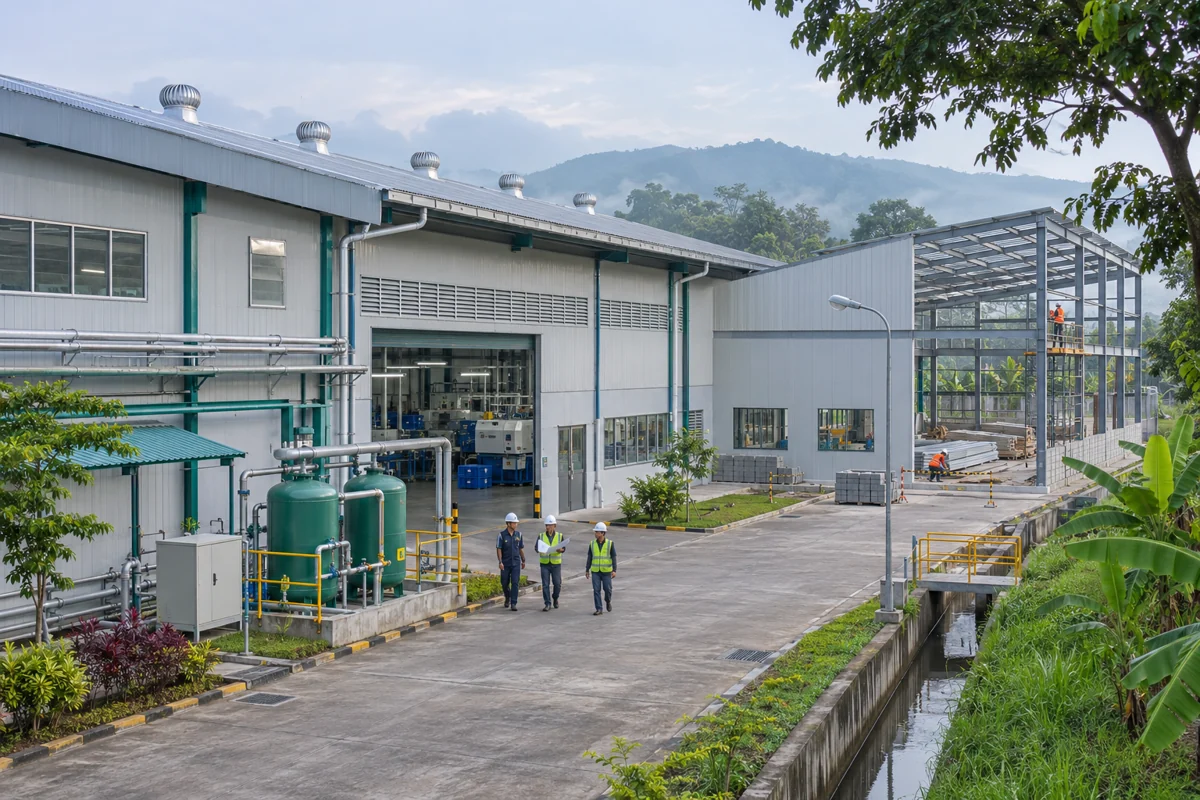
Start with the approved scope of the plant
The project team plans to add a production line. The new machines fit inside the existing building, but capacity will rise, equipment cleaning will be more frequent and operating hours will increase. The building work may look straightforward. For the environmental team, the first question is whether the existing approval covers the proposed change.
Open the environmental approval, its supporting documents and the latest amendments. Use three columns to distinguish the approved scope, actual operations and the post-expansion plan. Record the unit and time period for each figure. The difference between actual production and approved capacity matters when the team sets the baseline for screening.
- Review the current approvalCheck capacity, site boundaries, process, supporting facilities and monitoring commitments.
- Map changes and impactsCompare the plan with the approval and with traceable operating data.
- Screen the proposed changesUse the screening outcome to select the approval pathway and sequence technical work.
Which changes should the team review?
Indonesia’s Government Regulation No. 22 of 2021, Article 89, lists increased capacity, expansion of the site, changes in operating periods or duration, and technical changes affecting the environment as criteria for amending an environmental approval. A single project can trigger several criteria. A new line can increase capacity, introduce processing aids, extend operating hours and raise wastewater flows. See Government Regulation No. 22 of 2021, Articles 89–95.
| Proposed change | What to compare | Evidence for screening |
|---|---|---|
| Additional lines or capacity | Approved capacity, actual output and proposed capacity. | Product list, number of lines, consistent production units and operating schedule. |
| New equipment, processes or materials | Changes in water, energy, chemical use, emissions and waste. | Before-and-after process flows, equipment list and material or water balance. |
| Site expansion | Site boundaries, land use, drainage and affected receptors. | Coordinates, layout, construction plan and drainage drawings. |
| New shifts or longer operating hours | Operating hours, cleaning patterns, peak flow, traffic or night-time noise where relevant. | Current shift records, proposed schedules and comparable monitoring data. |
Use screening to determine the AMDAL, UKL-UPL or addendum pathway
Article 90 distinguishes environmental approval changes that require new environmental documentation from those that can proceed without it. For technical changes covered by Article 89(2)(a) to (g), Article 91 sets out pathways involving a new AMDAL, a UKL-UPL form, or an ANDAL and RKL-RPL addendum. Screening determines the applicable pathway based on the proposal and project conditions. If the proponent is unable to complete self-screening, Article 94 provides for submitting a request for a screening determination to the competent environmental authority, accompanied by environmental information. Read the full regulation in Indonesian.
For the screening review, describe the proposal in terms more specific than “new equipment”. Record which units are changing, their capacity, the planned start date and impacts that differ from the current approval. If the company identity and production capacity are both changing, document them separately so the administrative and technical changes can each be assessed on the right basis.
Worked example of expansion within the existing building
Consider a plant aiming for 18,000 tonnes per year on the same site footprint. The figures below are illustrative and separate approved production capacity, current operations and future treatment loads.
| Indicator | Approved or designed | Actual | After expansion |
|---|---|---|---|
| Annual capacity or output | 12,000 tonnes/year approved | 9,000 tonnes/year produced | 18,000 tonnes/year capacity |
| Average wastewater flow | Treatment design basis 100 m³/day | 80 m³/day measured | 120 m³/day estimated |
| Operational footprint | 2 hectares | 2 hectares | 2 hectares |
Proposed capacity is 50% higher than the approved capacity. Forecast average wastewater flow also exceeds the treatment design basis. Schedule screening for the change and assess treatment capacity against peak flow, pollutant load and wastewater variability. Check whether the project changes conditions covered by the wastewater technical approval, known as Pertek, and related operating approvals. Guide to wastewater Pertek and SLO · Industrial wastewater treatment audit guide.
Bring one set of project data to the first review. The permitting team brings the latest approvals and commitments, engineering brings specifications and before-and-after drawings, and EHS brings monitoring data and assumptions that need testing. A shared comparison table lets all teams update the same figures as the design changes.
Ganeca case study
Wastewater technical assessment at Arutmin Batulicin
For a proposed mine wastewater discharge, Ganeca examined upstream and downstream conditions and seasonal variability in the receiving water. A principle that applies to factory expansion planning is to test design assumptions against the wastewater sources, discharge point and receiving environment.
Read the case study →Technical references
Related services
Environmental Documentation & Permitting
For teams assessing changes, preparing for screening and defining the scope of AMDAL, UKL-UPL or an applicable addendum.
Explore environmental permitting →Wastewater Pertek & SLO
For facilities reviewing flow, treatment capacity, discharge points or technical conditions as processes change.
Explore Pertek & SLO support →Review Your Environmental Approval Before Expansion
Bring the project information you already have to the first discussion.
- Current environmental approval and latest amendments
- Before-and-after capacity, processes and layout
- Wastewater forecast and existing treatment data