Domestic Wastewater Treatment for Factories, Hotels, and Industrial Estates
Check the sources, flow profile, and effluent destination before sizing a domestic wastewater plant. This guide covers relevant Indonesian effluent limits, treatment options, and a worked example of an expansion.
Map wastewater sources and the treated effluent destination
At a hotel, the kitchen is busiest before the restaurant opens, the laundry runs in batches, and bathroom use rises with occupancy. At a factory, the canteen and toilets can send much of the daily flow to treatment around shift changes. Two facilities with the same average daily flow can need different equalization volumes and operating schedules.
Start with the drainage plan. Mark toilet wastewater and non-toilet flows from showers, washbasins, pantries, kitchens, or laundries. Map stormwater and process wastewater along their own routes. At a food plant, for example, equipment washdown and canteen wastewater are distinct sources. At an industrial estate, mark where tenant responsibility ends and estate responsibility begins, including who meters the flow and where samples are collected.
- Map sources and destinationsTrace toilets, kitchens, and laundries to the connection, discharge, or reuse point.
- Measure flow and loadRecord hourly and daily variations under typical and busy conditions, then match them to representative influent tests.
- Set the design basisConfirm effluent criteria, pretreatment needs, footprint, power supply, and operator capacity.
For discharge to a collection network that meets Article 5 conditions, obtain the operator’s requirements in writing. Confirm which streams the network accepts, connection capacity, pretreatment conditions, handover points, and responsibility for testing. When domestic and process wastewater share a treatment system, Article 4 and Appendix II govern how the integrated effluent limits are calculated. Document the flow and characteristics of each stream and check whether the current approvals support the proposed arrangement. Regulation No. 11/2025, Articles 4–5 and Appendix II (Indonesian).
Indonesia’s domestic wastewater limits under Regulation No. 11/2025
Ministry of Environment/Environmental Control Agency Regulation No. 11 of 2025 took effect on 9 September 2025 and repealed Regulation P.68/2016. Appendix I sets limits according to the type of wastewater and the effluent destination. The following table shows selected limits for non-toilet wastewater or combined toilet and non-toilet wastewater treated separately from other wastewater and discharged to receiving waters. Consult the applicable provisions for discharge to drainage or irrigation channels and for reuse. BPK legal database · Regulation status and text (Indonesian).
| Parameter | ≤3 m³/day | >3–50 m³/day | >50 m³/day |
|---|---|---|---|
| BOD, mg/L | 75 | 50 | 30 |
| COD, mg/L | — | 100 | 100 |
| TSS, mg/L | — | 50 | 30 |
| Ammonia (NH₃-N), mg/L | — | 20 | 10 |
| Oil and grease, mg/L | 10 | 10 | 5 |
A dash indicates a blank cell in Appendix I A.2. Read the full table and footnotes before setting the monitoring program, including pH, bacterial indicators, and the provisions for detergents where washing or laundry takes place. Check the conditions in the facility’s approvals as well. Article 6 and Appendix III set treatment technology standards by effluent destination and volume, including the discharge categories of ≤3 and above 3 through 50 m³/day. Full regulation and appendices (Indonesian).
Choose a system the facility can run every day
Use daily flow, hourly peaks, and pollutant loads together to size treatment units. For an initial check, multiply the flow (m³/day) by the concentration (mg/L) and divide by 1,000 to get kilograms per day. At an operating facility, compare flow records with shifts, kitchen hours, laundry cycles, and occupancy. Sample under conditions that capture these changes.
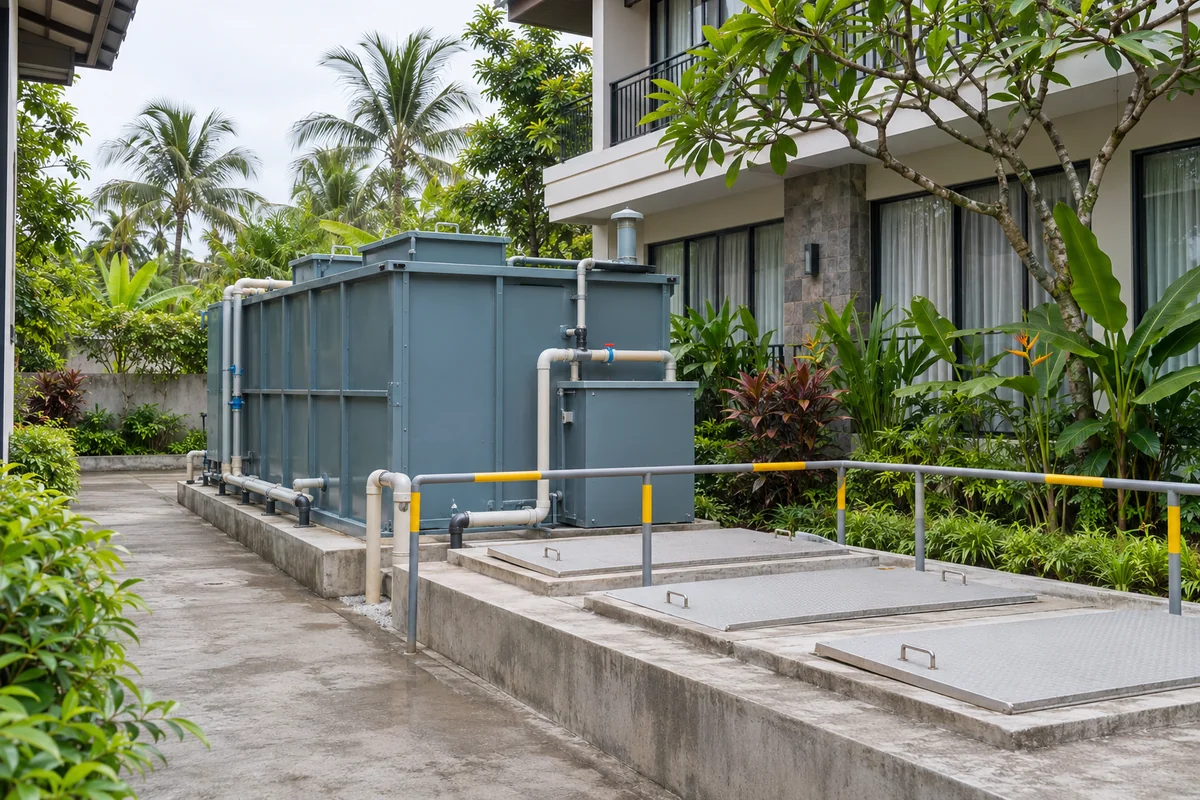
The treatment train depends on the wastewater characteristics and the effluent destination. Article 8 requires an oil and grease separator for domestic wastewater containing oil and grease. Equalization buffers peaks before biological treatment. After biological treatment, check how solids will be separated and whether disinfection or further polishing applies. Make room for screen cleaning, sludge withdrawal, pump replacement, and sampling. Where feasible, allow maintenance while the rest of the plant continues to operate.
| Process | What to check in the design | What operators need to maintain |
|---|---|---|
| Extended-aeration activated sludge | Aeration volume, oxygen demand, settling and return sludge capacity. | Blower inspections, settling checks, and a schedule for wasting excess sludge. |
| Sequencing batch reactor (SBR) | Buffer capacity during settling and decanting and response to peak inflows. | Check the control sequence, pumps, valves, and decanter. |
| Attached-growth biofilter | Media loading, flow and oxygen distribution, and downstream solids separation. | Inspect media and maintain access for clearing blockages. |
Ask each supplier for average and peak capacity, assumed influent quality, effluent targets, equipment power, and sludge handling arrangements. Compare annual costs for electricity, consumables, testing, and sludge removal. Include the design conditions and performance test criteria in the handover. US EPA · Technical reference on package plants and SBRs.
Worked example for a hotel adding rooms and laundry capacity
Assume a hotel has a dedicated plant for combined toilet and non-toilet wastewater and discharges treated effluent to receiving waters. On the busiest monitored day, it generates 38 m³/day. With more rooms and laundry equipment, the projected busy-day flow reaches 52 m³/day. Assuming influent BOD stays at 250 mg/L, the BOD load rises from 9.5 to 13 kg/day. These are worked-example figures. The facility should verify the concentration again once operations change.
In this scenario, the projected volume crosses the 50 m³/day threshold. The applicable Appendix I A.2 BOD limit drops from 50 to 30 mg/L. Before ordering equipment, check equalization when the kitchen and laundry peak together, aeration and settling at the higher load, and the facility’s approval conditions. If an existing outlet test already exceeds a limit, start by tracing the causes of poor treatment performance so the proposed upgrade addresses the right problem.
At a factory, repeat this review when staffing per shift or canteen capacity changes. At an industrial estate, forecast tenant connections and the start dates for each phase. In each setting, keep a design basis that can be updated as measured data become available.
Ganeca case study
Modular communal wastewater treatment design for PT Timah
Ganeca developed a modular design basis for support facilities across PT Timah work sites handling 15–50 m³/day. Unit sizes were adapted for site flows, and inlet and outlet meters helped operators track flow. The case shows how a common design can be adapted to sites with different loads and operating constraints.
Read the case study →Technical references
Related services
Water and Wastewater Treatment Solutions
Compare upgrades, extra capacity, or a new treatment plant using flow records and test results.
Explore wastewater treatment services →Wastewater Pertek & SLO
Review technical requirements if capacity, treatment, discharge point, or effluent use changes.
Explore Pertek & SLO support →Review Your Domestic Wastewater Treatment Needs
Bring the information you already have to the first discussion.
- Drainage plan and effluent destination
- Flow records, occupancy or staffing
- Influent and effluent results and current approvals