Mine Water Characterization from Settling Behavior to Metal Partitioning
Settling tests and paired total and dissolved metal results help determine which treatment steps mine water needs.
Characterize the solids before selecting a process
Two mine water samples can look equally turbid and have high TSS while requiring different treatment. In one, solids can settle by gravity. In another, fine particles or colloids remain suspended. I start with settling behavior and metal partitioning alongside TSS. Together, these results indicate which fractions can be removed physically and which need further process testing.
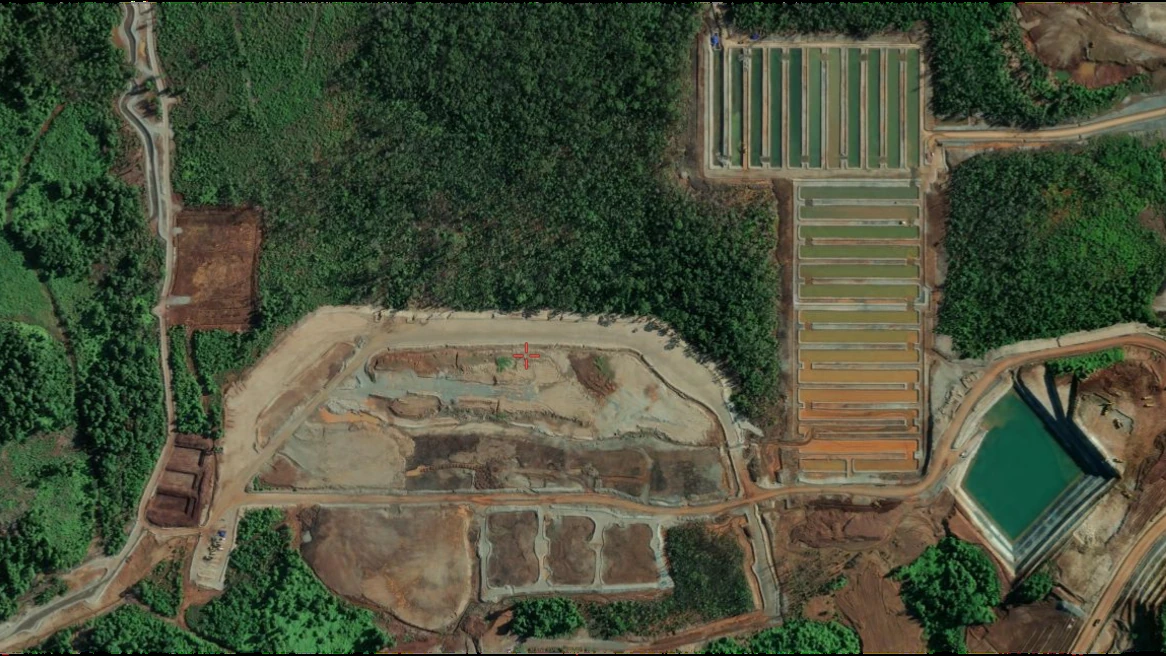
Design sampling around the sources and flow paths. Pits, haul roads, stockpiles, and disturbed areas can contribute different materials. Record weather, operating conditions, and sampling times. When the decision involves sizing a pond, capture high-flow conditions and dry periods so the tests cover a relevant operating range.
Compare total and dissolved metals
In work described in the original article, researchers from ITB’s Water and Wastewater Engineering Research Group and I examined a nickel mine water sample. The following results show why treatment decisions need to account for how metals are distributed between fractions.
| Metal | Total (mg/L) | Dissolved (mg/L) |
|---|---|---|
| Nickel (Ni) | 12.9 | <0.002 |
| Iron (Fe) | 571 | <0.002 |
| Chromium (Cr) | 3.5 | Approximately 0.2 |
The large difference between total and dissolved results suggests that particle removal is worth testing for Ni and Fe in this sample. Chromium remained measurable in the dissolved fraction, and the original article reports Cr(VI) in that fraction. Confirm the analytical methods are comparable. The operational definition of dissolved depends on sample preparation, and some colloids can pass through filters. Preserve the “less than” reporting limits when interpreting the data. USGS · How filtration affects dissolved-metal results.
Use settling and jar tests to answer different questions
In one test I reported, about 87% of the solids settled by gravity without chemical addition. The value applies to those test conditions. To translate the result into pond design, consider the settling curve, flow and effective surface area, flow distribution, and sediment accumulation. Surface overflow rate is the flow divided by effective surface area. Hydraulic checks still matter when nominal volume appears adequate. Diagnosing sediment pond outlet TSS after rain.
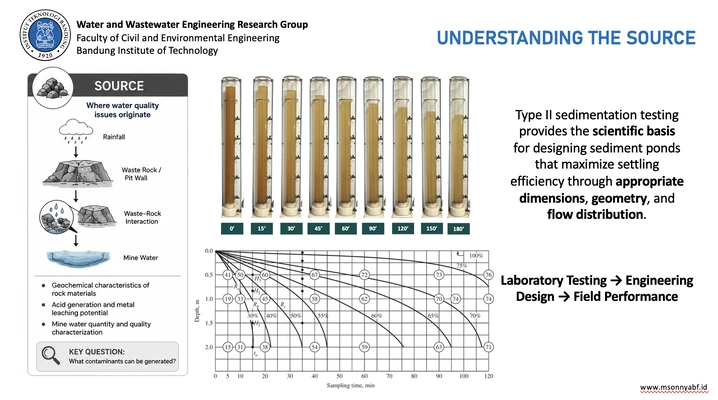
Use jar tests to assess how the remaining slowly settling material responds to treatment under different water quality conditions. If speciation indicates that dissolved metals remain a concern, test processes that address that fraction. Where Cr(VI) is present, consider source geochemistry and obtain test results that distinguish Cr(VI) from total chromium. Cr(VI) dynamics in nickel mining.
Translate test results into design decisions
If gravity settling is effective, evaluate pre-settling and sludge management first. For particles that remain suspended, use test data to assess coagulation, flocculation, and subsequent solids separation. Where dissolved contaminants remain, select further treatment based on speciation. Record the conditions behind each choice and how performance will be verified on site. Guide to selecting mine water treatment technology.
Ganeca case study
Runoff characterization at the Pani Gold Project
Ganeca combined water and sediment characterization, settling tests, jar tests, and hydrological analysis to develop recommendations for site conditions.
Read the case study →Technical references
Related services
Review Your Mine Water Characterization Plan
Bring the information you already have to the first discussion.
- Water sources, drainage routes, and sampling locations
- Water, sediment, or mineralogy test results
- Flow records and operating conditions