Understanding Hexavalent Chromium (Cr(VI)) in Nickel Mining
Laterite geochemistry and mine water management help explain how Cr(VI) forms, moves, and can be monitored.
Why chromium speciation matters
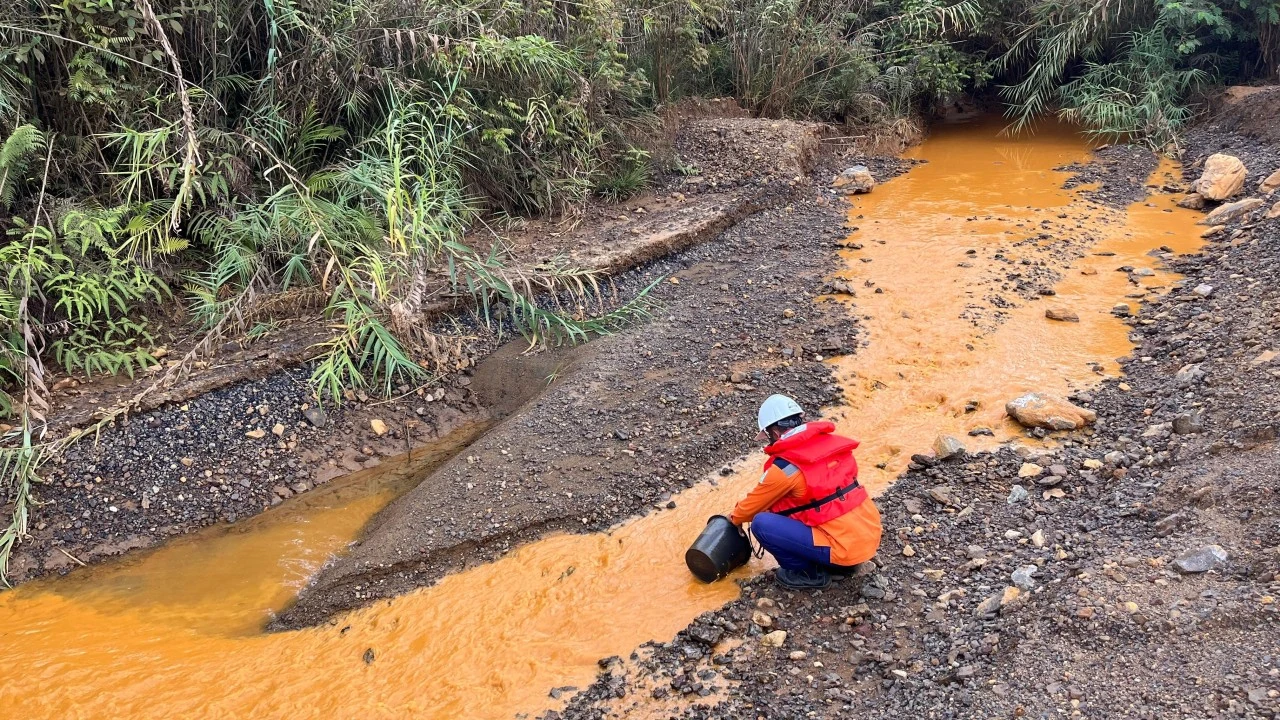
Red runoff at nickel mines often reflects iron-rich sediment. To understand chromium, I start with a separate question: which forms occur in the rock, sediment, and water leaving contact areas? Trivalent chromium (Cr(III)) and hexavalent chromium (Cr(VI)) differ in mobility, solubility, and toxicity. Pairing total chromium measurements with speciation helps characterize those differences in the field.
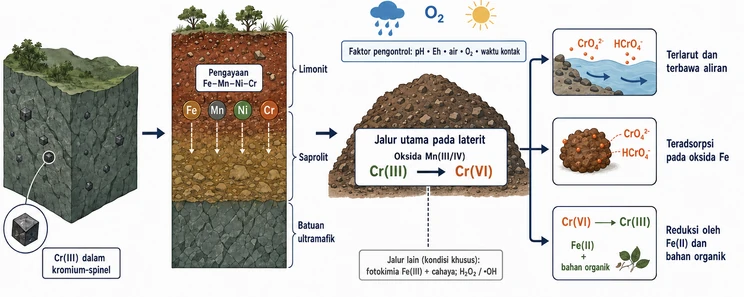
In laterite formed by weathering of ultramafic rock, chromium can be held in chromium-bearing minerals such as spinel and associated with other mineral phases. Its distribution may vary by horizon. For example, a study in Pomalaa found chromium enrichment in the limonite zone at the site it examined. Mineralogy helps identify which materials to test. Estimating how much Cr(VI) travels with water also requires data on flow paths and contact conditions. Pomalaa laterite mineralogy study.
Formation, retention, and reduction of Cr(VI)
Reactive manganese oxides can accept electrons from Cr(III) and promote Cr(VI) formation. Dissolved oxygen helps sustain oxidizing conditions, while direct oxidation of Cr(III) by oxygen is generally slow under environmental conditions. The Cr(VI) that forms may travel with water, adsorb onto mineral surfaces such as iron oxides, or be reduced by electron donors such as ferrous iron (Fe(II)). The relative importance of these pathways depends on pH, redox conditions, mineralogy, and contact time. USGS · Hexavalent chromium geochemistry.
| Process | Question to investigate |
|---|---|
| Cr(VI) formation | Can available chromium interact with reactive manganese oxides? |
| Retention on solids | How do pH and mineral surfaces such as iron oxides affect the fraction carried by water? |
| Reduction | Are ferrous iron or other electron donors available in the water or sediment being studied? |
Monitor from the source to the outlet
Use comparable reference locations to establish the geogenic background. Sample contact areas such as pits, ore and waste rock stockpiles, collection drains, and pond inlets and outlets. Pair Cr(VI) and total chromium with pH, redox conditions, dissolved oxygen, and flow. Ferrous iron, dissolved manganese, and organic carbon can help test proposed mechanisms. Agree on analytical methods, reported fractions, and Cr(VI) sample handling with the laboratory before fieldwork.
During rain, interpret concentration alongside flow and sampling time. For example, 0.10 mg/L at 100 m³/h gives 10 g/h, while 0.05 mg/L at 400 m³/h gives 20 g/h. The concentration falls while the load rate increases. To evaluate changes in source and transport, compare similar storm phases and record operating conditions. Mine water accounting guide.
Use geochemistry to guide mine water management
Mapping flow paths helps identify where separating contact and non-contact water could reduce the volume that needs treatment. Review stockpile layout, drainage, and contact time between water and exposed material. At the pond, assess solids removal and changes in dissolved chromium separately. Where Cr(VI) remains measurable after clarification, use speciation results and representative water quality and flow data to scope treatability tests. Guide to choosing mine water treatment technology.
Ganeca case study
Runoff characterization at the Pani Gold Project
Ganeca combined water and sediment characterization, settling tests, jar tests, and hydrological analysis to develop recommendations for site conditions.
Read the case study →Technical references
Related services
Review Your Mine Water Characterization Plan
Bring the information you already have to the first discussion.
- Water sources, drainage routes, and sampling locations
- Water, sediment, or mineralogy test results
- Flow records and operating conditions