Dead Zones in Sediment Ponds. How Much Pond Volume Is Used Effectively?
Understanding hydraulic flow patterns can help improve sediment settling in ponds.
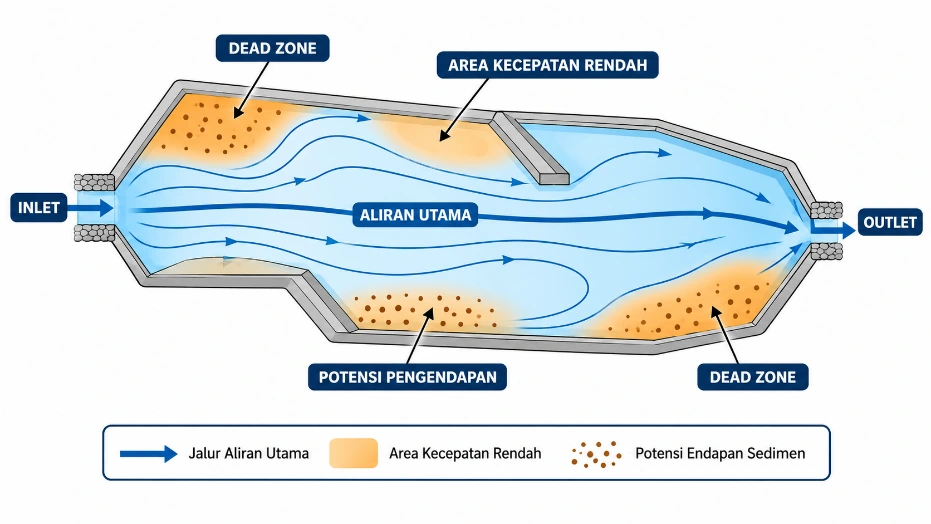
In mining operations, sediment ponds help control surface runoff that carries sediment before it reaches a receiving water body. Their effectiveness depends on pond storage capacity and how water flows through the pond. One hydraulic feature worth examining is the presence of dead zones.
What is a dead zone in a sediment pond?
A dead zone is an area of the pond where flow is very slow, circulation is limited, or water moves through it inefficiently. These conditions can arise from the pond geometry, changes in cross-section, embankments or internal structures, and the way flow is distributed between the inlet and outlet.
Dead zones can have two effects. Sediment may accumulate where flow is slow. Uneven flow distribution can also leave part of the pond volume underused for settling.
When flow concentrates along a particular path, short-circuiting can occur. Water moves relatively quickly from the inlet to the outlet and uses only part of the pond volume effectively. As a result, hydraulic retention times vary across the pond and particle settling can become less effective.
Identifying dead zones with hydrodynamic modelling
One way to assess these patterns is to model the flow in HEC-RAS and display the simulation results in RAS Mapper.
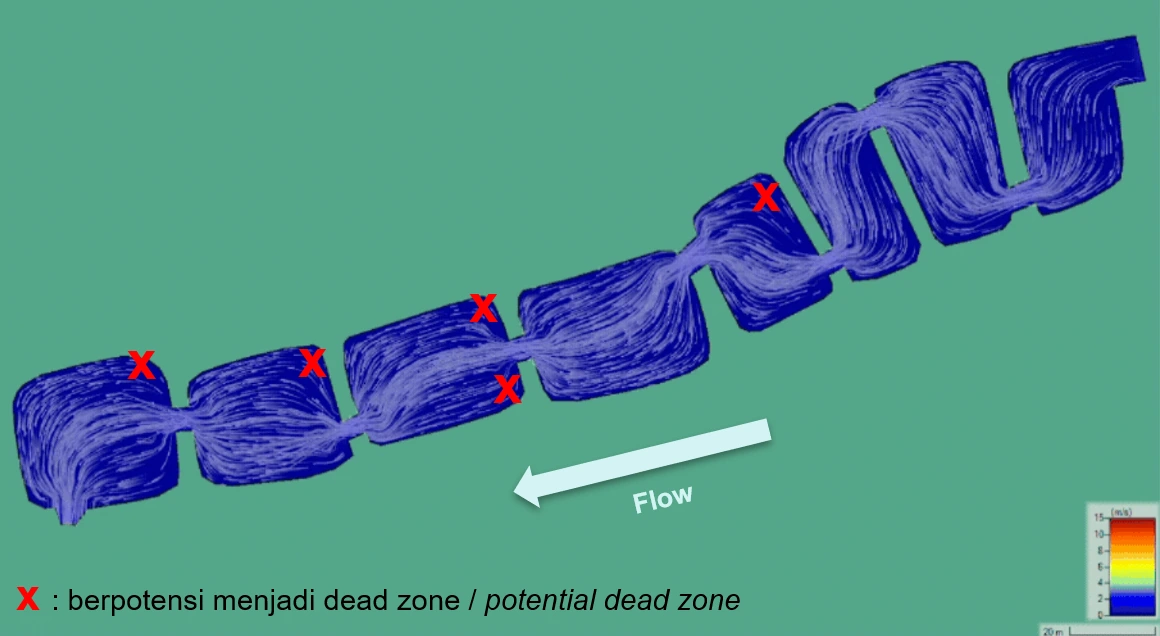
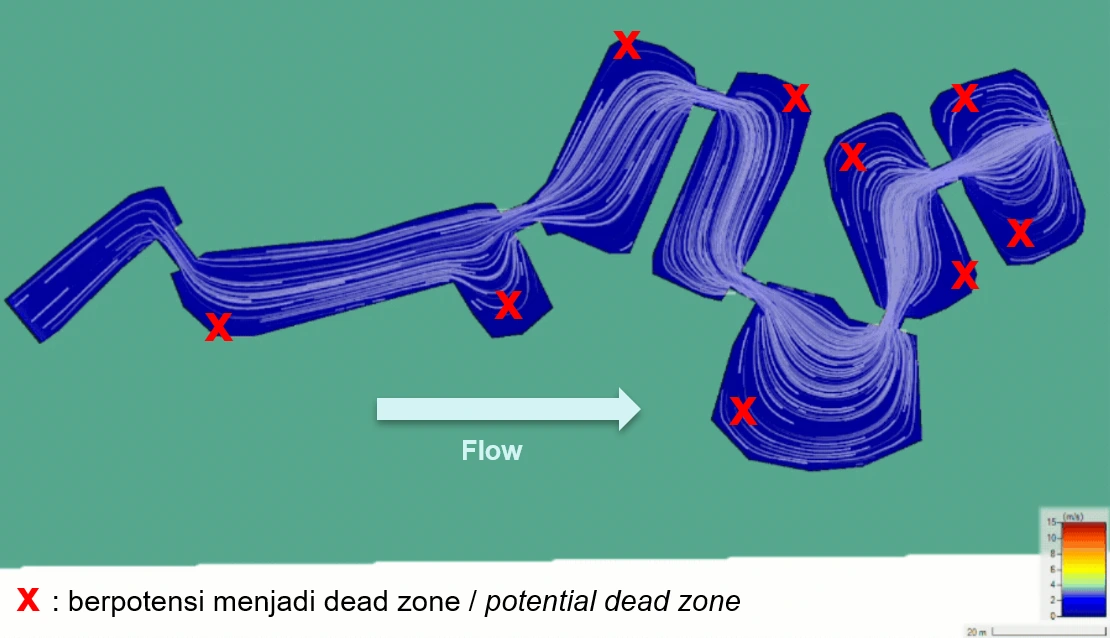
Simulations of several sediment pond areas show that flow patterns vary within the ponds and in the connecting channels. Concentrated flow paths and localized circulation can help identify areas where water movement may be less effective.
Use the model results to examine flow velocities, the direction of the velocity vectors, water depths, and circulation patterns across the pond. Areas of low velocity warrant further assessment to determine where sediment may settle and where effective storage volume may be reduced.
Why should dead zones be managed?
Identifying dead zones provides a basis for improving sediment pond performance. Where sediment settles unevenly, it can build up in particular areas, reduce effective storage volume, and increase dredging and maintenance needs.
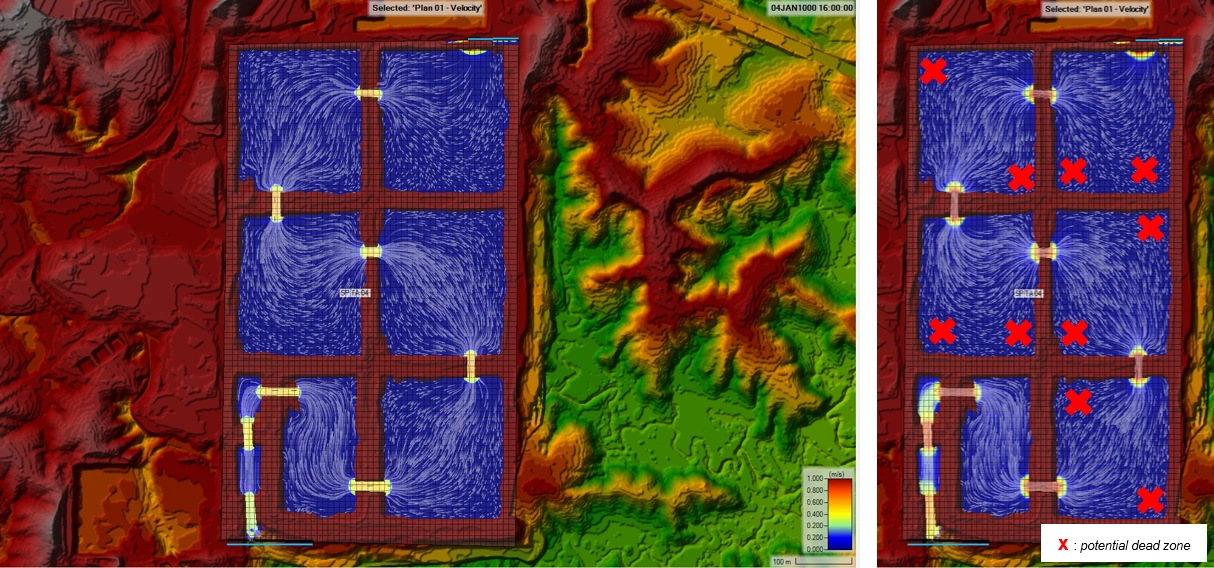
Hydrodynamic results can inform changes to the inlet and outlet configuration, the use of flow deflectors or baffles, and changes to pond geometry. They can also help determine where dredging may be needed to remove accumulated sediment.
Conclusion
Dead zones can affect sediment pond performance. Hydrodynamic modelling helps assess how flow is distributed across a pond and identify potential areas of limited circulation, sediment accumulation, and short-circuiting.
An effective sediment pond needs enough storage and a flow pattern designed and managed to support sediment settling.
Ganeca case study
Sediment pond capacity assessment at the Pani Gold Project
At the Pani Gold Project, Ganeca combined runoff characterization, settling tests, and jar tests with hydrological analysis and checks on detention time and surface overflow rate to inform treatment and pond development recommendations.
Read the case study →Technical references
Related services
Mine Environmental Studies
Assess runoff, flow paths, and pond conditions through hydrology, modelling, and field observations.
Explore mine environmental studies →Water and Wastewater Treatment Solutions
Review settling and treatment options using water quality, flow data, and treatment targets.
Explore water treatment services →Discuss Your Sediment Pond Hydraulics
Bring the information you already have to the first discussion.
- Pond layout and bed elevations
- Flows and inlet and outlet conditions
- Sediment, dredging, or model records